No Product Added

By : Shah Electronics
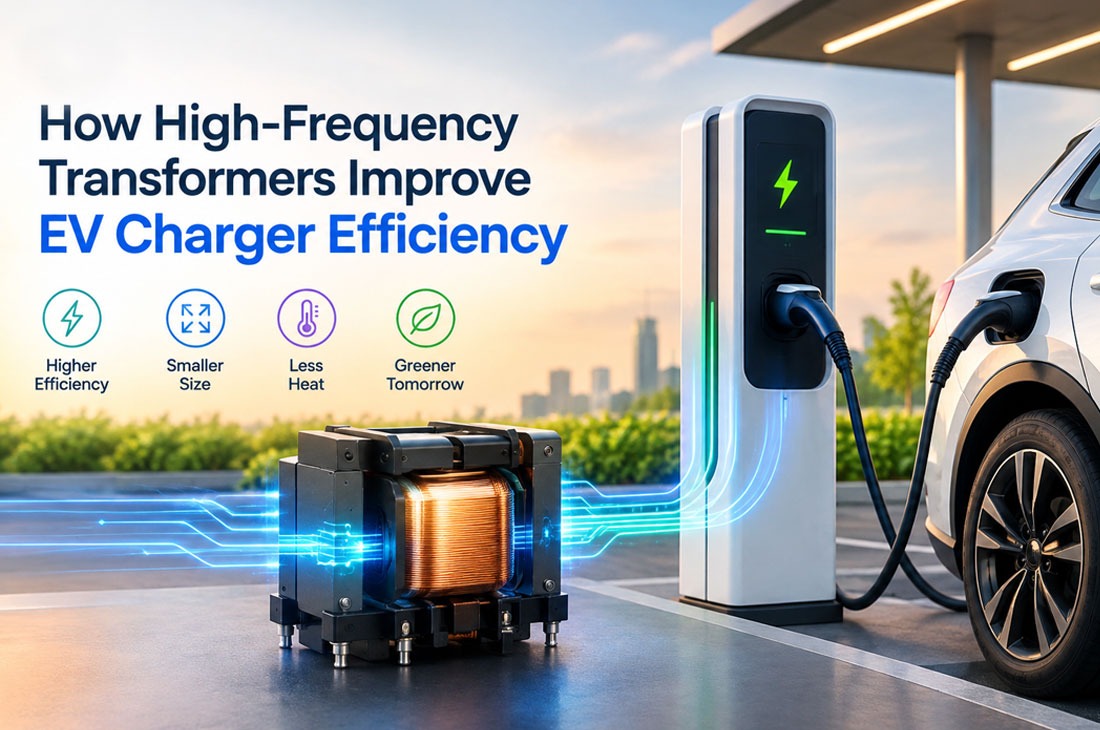
Electric vehicles are no longer a "future" technology they're on our roads today, and the charging infrastructure behind them has to keep up. Whether it's an onboard charger tucked inside your car or a fast-charging station at a highway rest stop, one component quietly makes all the difference in how efficiently that charger works: the High-Frequency Transformer.
If you've ever wondered why modern EV chargers are smaller, cooler, and faster than older charging systems, the answer lies in this small but powerful piece of engineering. Let's break down how it works and why it matters.
What Is a High-Frequency Transformer?
A traditional power transformer operates at low frequencies (typically 50Hz or 60Hz), which means it needs large iron cores and heavy copper windings to handle the power load. That's fine for a factory floor, but it's not practical for a compact EV charger that needs to fit under a car's hood or inside a wall-mounted unit.
A high frequency transformer, on the other hand, operates at much higher switching frequencies often in the range of tens or hundreds of kilohertz. This higher frequency allows the transformer's core and windings to shrink dramatically in size while still handling the same (or greater) amount of power. Essentially, it does more work in a smaller, lighter package.
Why Efficiency Matters in EV Charging
Every time energy is converted from one form to another AC to DC, high voltage to low voltage some energy is lost as heat. In an EV charging system, these conversions happen multiple times before power actually reaches the vehicle's battery. The efficiency of each conversion stage directly affects:
This is exactly where the high-frequency transformer proves its value. By operating at higher switching frequencies, it minimizes energy losses, reduces heat generation, and allows power electronics to convert energy far more efficiently than older, low-frequency designs.
Power Conversion, Isolation, and Compact Design — All in One
A well-designed EV charger transformer does three critical jobs at once:
1. Efficient Power Conversion High-frequency switching allows power converters to process energy with fewer losses. This means more of the electricity drawn from the grid actually reaches the vehicle's battery instead of being wasted as heat.
2. Electrical Isolation Safety is non-negotiable in EV charging. A transformer provides galvanic isolation between the high-voltage input side and the low-voltage output side, protecting both the vehicle and the user from electrical faults. This isolation barrier is essential in both onboard chargers and public fast-charging stations.
3. Compact, Lightweight Design Because higher frequency operation reduces the required core size, manufacturers can build smaller, lighter charging units. This is especially important for onboard chargers, where every kilogram affects the vehicle's overall efficiency and range.
Role in Onboard Chargers
The onboard charger (OBC) inside an EV converts AC power from a home or public outlet into DC power that charges the battery. Since this unit lives inside the vehicle, space and weight are at a premium. A compact high frequency transformer allows OBC manufacturers to design lighter, more efficient units without sacrificing charging speed or safety.
Role in DC-DC Converters
EVs don't just need AC-to-DC conversion they also need DC-DC transformer stages to step voltage up or down between the battery, auxiliary systems, and various vehicle electronics. High-frequency transformers make these DC-DC converters smaller and more thermally efficient, which improves the overall reliability of the vehicle's power architecture.
Role in Fast-Charging Systems
Public fast-charging stations push large amounts of power in a short time, which puts enormous stress on internal components. An efficient EV charging transformer is critical here it helps manage high power throughput while keeping heat and energy loss to a minimum, allowing fast chargers to deliver reliable performance charge after charge.
The Bigger Picture: A More Efficient EV Ecosystem
From the charging cable to the battery cell, every component in an EV's power path affects overall efficiency. A high-quality power transformer designed for high-frequency operation isn't just a technical upgrade it's a foundational part of making EV charging faster, safer, and more sustainable.
As EV adoption grows, the demand for precise, dependable, and compact transformer solutions will only increase. Manufacturers and engineers who prioritize high-frequency transformer technology are helping build the backbone of a cleaner, more efficient transportation future.
Reliable current monitoring is just as important as efficient power conversion in EV charging systems. Shah Electronics' High Accuracy Precision Current Transformers are engineered to deliver dependable current measurement and electrical isolation, supporting accurate monitoring and protection across energy and charging systems.
FAQs
Q1. What makes a high-frequency transformer different from a standard transformer? A high-frequency transformer operates at much higher switching frequencies than a standard 50/60Hz power transformer, allowing it to be smaller, lighter, and more efficient at converting power.
Q2. Why is electrical isolation important in EV chargers? Isolation protects the vehicle, the charging equipment, and the user from electrical faults by keeping the high-voltage and low-voltage sides of the system electrically separated.
Q3. How do high-frequency transformers improve fast charging? They help manage high power loads with lower energy losses and less heat buildup, allowing fast chargers to deliver consistent, reliable performance.
Q4. Are high-frequency transformers used only in EV chargers? No. While they play a major role in onboard chargers and DC-DC converters for EVs, high-frequency transformers are also used in various power electronics applications requiring compact, efficient energy conversion.
Q5. Does Shah Electronics offer transformer-related monitoring solutions? Yes. Shah Electronics manufactures High Accuracy Precision Current Transformers designed for reliable current measurement, monitoring, and protection in electrical and electronic systems, including EV and energy infrastructure applications.
© 2025. Shah Electronics. All Rights Reserved. Terms of Use Privacy Policy Cookie Policy
Terms of Use
Privacy Policy
Cookie Policy
© 2025. Shah Electronics. All Rights Reserved.
Powered by WEBMANTRA