No Product Added

By : Shah Electronics
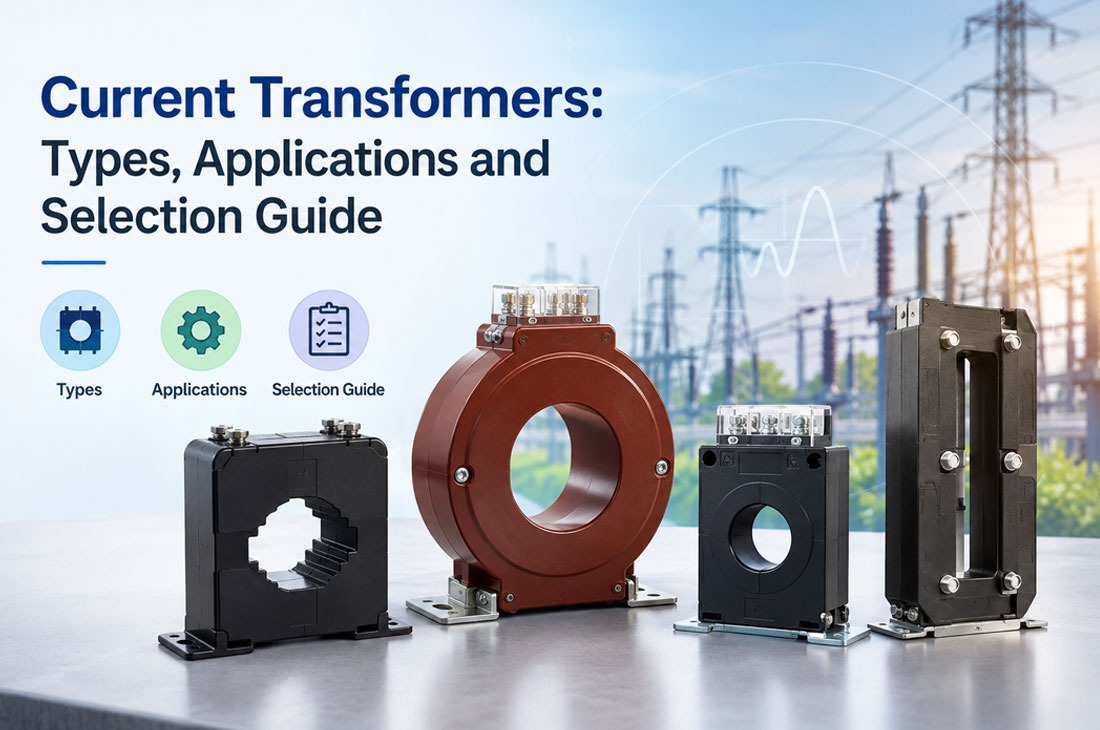
If you've spent any time around electrical panels, energy meters, or power monitoring systems, you've probably come across a small ring-shaped or box-like component quietly doing one of the most important jobs in the entire system measuring current safely. That component is the current transformer, and despite its unassuming size, it plays a huge role in protection, metering, and monitoring across almost every kind of electrical setup.
In this guide, we'll break down what current transformers actually do, the different types available, how accuracy classes work, and the key factors you should think about before choosing one for your application.
What Is a Current Transformer?
A current transformer, often shortened to CT transformer, is a device used to measure alternating current by producing a reduced, proportional current in its secondary winding. Instead of connecting expensive and bulky measuring equipment directly to a high-current line, engineers pass that line through (or near) the CT, which safely scales the current down to a level that meters, relays, and protection devices can handle.
This makes current transformers essential wherever high currents need to be measured, monitored, or used to trigger protective action without ever exposing sensitive equipment or personnel to that high current directly.
How Current Transformers Work
The working principle is refreshingly simple. A CT has a primary winding (often just the cable itself passing through the core) and a secondary winding wound around a magnetic core. As current flows through the primary side, it creates a magnetic field in the core, which induces a proportional current in the secondary winding.
The ratio between primary and secondary current is fixed by the transformer's design for example, a 100:5 CT will produce 5A on the secondary side for every 100A flowing through the primary. This scaled-down signal is what actually gets read by meters, protection relays, or monitoring systems.
Because this is essentially a current sensing transformer relationship, the accuracy and stability of that ratio under different load conditions is what separates a good CT from a mediocre one.
Types of Current Transformers
Not all CTs are built for the same job. Broadly speaking, current transformers fall into a few key categories:
1. Metering Current Transformers
A metering current transformer is designed for high accuracy under normal operating conditions typically from about 5% to 120% of rated current. These are the CTs you'll find in energy meters and billing systems, where precision at everyday load levels matters far more than performance during a fault. They're intentionally designed to saturate quickly during large fault currents, which protects the connected metering equipment from damage.
2. Protection Current Transformers
Unlike metering CTs, protection CTs are built to stay accurate during fault conditions sometimes many times the rated current so that protective relays can detect and respond to abnormal situations quickly. Accuracy at normal load isn't the priority here; reliable performance during a short circuit or overload is.
3. Current Sensing Transformers
A current sensing transformer is typically used in lower-power applications like power supplies, motor drives, and control circuits, where the goal is simply to monitor current levels for feedback, control, or basic overcurrent detection rather than precision billing or grid-level protection.
4. Precision Current Transformers
A precision current transformer is engineered for applications where measurement accuracy is critical think laboratory instrumentation, power quality analyzers, and high-end energy monitoring systems. These CTs are built with tighter tolerances and more stable performance across varying loads and temperatures.
5. Wound, Toroidal, and Bar-Type CTs (By Construction)
Beyond functional category, CTs also differ by physical design:
Understanding Accuracy Classes
Accuracy class is one of the most misunderstood specs on a CT datasheet, but it's fairly simple once broken down. It tells you how much the CT's actual output can deviate from the ideal ratio, under specified conditions.
Choosing the wrong accuracy class isn't just a technical mismatch it can lead to billing disputes, protection relays that don't trip when they should, or unnecessary costs on components with more precision than the application actually needs.
Applications of Current Transformers
Current transformers show up in more places than most people realize:
Key Factors When Selecting a Current Transformer
Choosing the right CT isn't just about picking a ratio and moving on. Here's what actually matters:
1. Application Type – Are you metering, protecting, or simply sensing current? This determines whether you need a metering-grade, protection-grade, or general-purpose CT.
2. Accuracy Requirements – Billing and lab-grade applications need tight accuracy classes; general monitoring can often work with more relaxed tolerances.
3. Rated Current and Ratio – The CT's primary and secondary current ratings need to match your system's actual operating range for reliable, undistorted readings.
4. Burden Rating – This refers to the maximum load the CT's secondary circuit can handle without losing accuracy an often overlooked but important spec.
5. Frequency and Waveform – Applications involving high-frequency switching or non-sinusoidal waveforms may need CTs specifically designed to handle those conditions accurately.
6. Physical Installation Constraints – Available space, cable size, and mounting method often dictate whether a toroidal, wound, or bar-type CT is the practical choice.
The Bottom Line
A current transformer might be a small, unassuming component, but it's foundational to how modern electrical systems measure, protect, and monitor power. Whether you're building an energy metering system, a protection scheme, or a power quality monitor, choosing the right type and accuracy class makes a real difference in system reliability and performance.
At Shah Electronics, our Current Transformer range is built to cover this wide spectrum of needs from precision metering to general-purpose current sensing with the accuracy and consistency that demanding applications require.
FAQs
Q1. What is the difference between a metering CT and a protection CT? A metering current transformer prioritizes accuracy at normal operating loads and is designed to saturate during faults to protect connected meters, while a protection CT is built to remain accurate even during high fault currents so relays can respond correctly.
Q2. What does the accuracy class of a CT actually mean? It indicates how closely the CT's output current matches the ideal ratio under specified conditions lower class numbers for metering CTs mean tighter accuracy, which is important for billing-grade measurement.
Q3. Can the same current transformer be used for both metering and protection? Generally, no. Metering and protection CTs are designed with different priorities, and using one in place of the other can lead to inaccurate billing or unreliable fault protection.
Q4. What is CT burden, and why does it matter? Burden refers to the load connected to a CT's secondary circuit. If the burden exceeds the CT's rated capacity, measurement accuracy can suffer, so it's an important factor to check during selection.
Q5. Does Shah Electronics offer precision current transformers for sensitive applications? Yes. Shah Electronics manufactures a range of current transformers, including precision and metering-grade options, suited for applications ranging from energy monitoring to industrial protection systems.
© 2025. Shah Electronics. All Rights Reserved. Terms of Use Privacy Policy Cookie Policy
Terms of Use
Privacy Policy
Cookie Policy
© 2025. Shah Electronics. All Rights Reserved.
Powered by WEBMANTRA