No Product Added

By : Shah Electronics
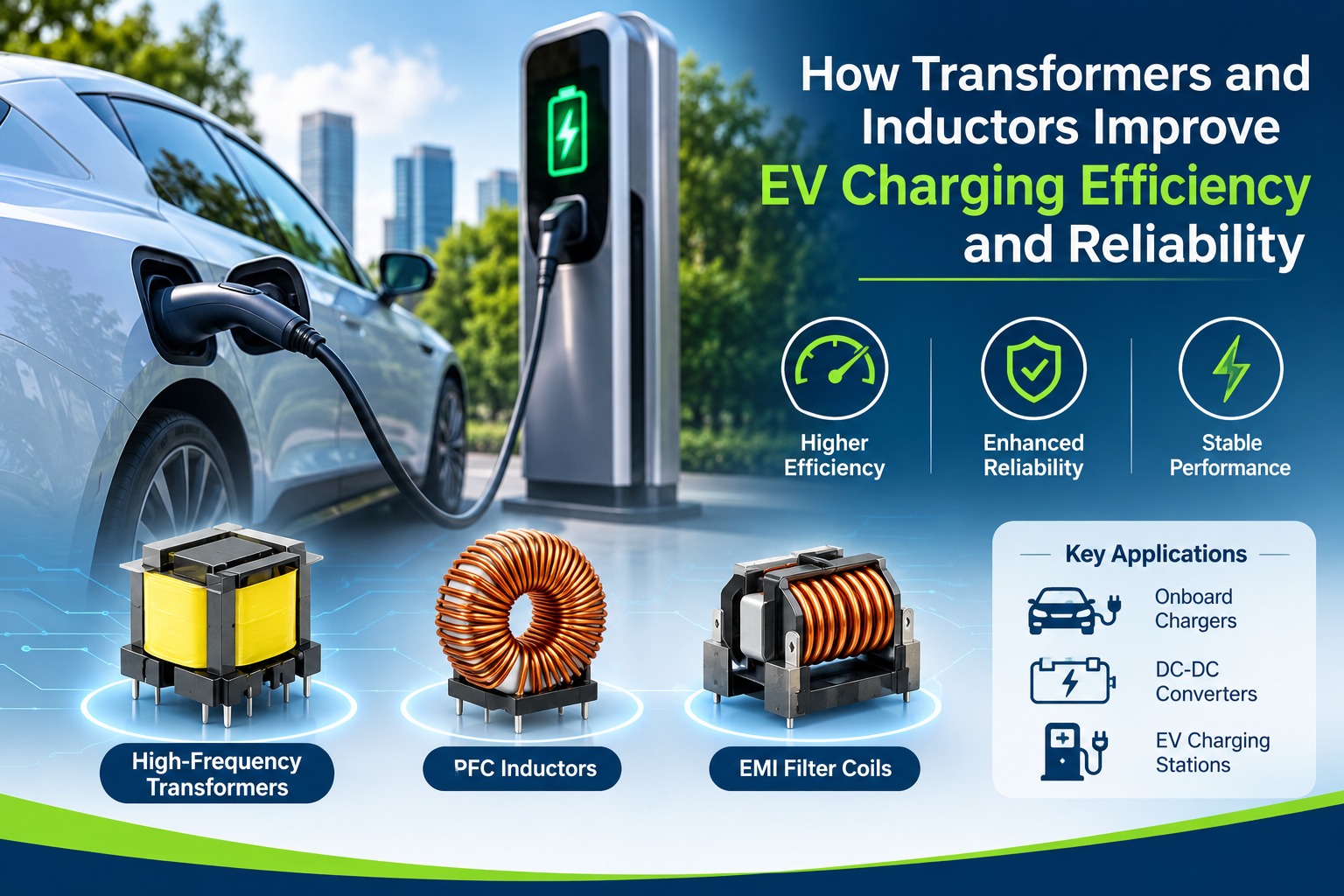
You park, plug in and walk away. The charger shows a green light, and a few hours later the battery is full. It feels effortless.
Inside the charger, though, there is a lot of quiet teamwork going on. Grid power is cleaned, shaped, boosted, isolated and fine-tuned before a single electron reaches your battery. The unsung team members doing that work are the magnetic parts: transformers and inductors for EV chargers.
Let's meet the three key players and see what each one does.
Think of charging as a relay race. Power passes through a few stages, and each stage has its own runner:
All of these stages rely on EV charging components like transformers, inductors and filter coils. Together, they form the core of EV power conversion.
Without correction, a charger tends to grab power from the grid in short, sharp gulps. That wastes energy and puts stress on cables and the grid itself.
A PFC inductor calms this down. It stores energy and releases it in a controlled way, so the current drawn from the grid follows the shape of the voltage. The benefits are simple:
In short, the PFC inductor makes the charger a polite guest on the power network.
Between the grid and the battery, you need a safe wall that still lets energy pass through. That is the job of the EV charger transformer.
A high-frequency transformer for EV charging does two things at once:
Because it works at high switching frequencies, it can be much smaller and lighter than an old-style transformer. That is a big reason modern chargers can be compact, even at high power. A well-designed DC-DC converter transformer also loses very little energy as heat, which is exactly what you want when moving a lot of power quickly.
Fast switching is the secret of efficient charging, but it creates electrical noise as a side effect. Left alone, that noise can disturb nearby electronics, confuse the charger's own control circuits and cause the product to fail EMC tests.
An EV charging inductor designed for filtering, known as an EMI filter coil or common-mode choke, stands guard at the input and output. It blocks unwanted high-frequency noise while letting useful power flow through. The result is a charger that behaves well in the real world, not just in the lab.
Every plug-in vehicle has an onboard charger that converts AC from a home or public socket into DC for the battery. Space and weight are tight, so compact high-frequency transformers and efficient PFC inductors are essential. EMI filter coils keep the OBC from disturbing the vehicle's other electronics.
Electric vehicles also use DC-DC converters to step the high-voltage battery down to power the 12 V systems, such as lights, infotainment and control units. Here, the transformer and inductors must stay efficient and cool across changing loads and temperatures.
Public fast chargers convert grid AC into high-power DC for rapid charging. They handle large currents, work for long hours and sit outdoors. This is where thermal stability, strong insulation and consistent quality become critical, because downtime means lost revenue and frustrated drivers.
Every bit of energy lost in a charger turns into heat. Good magnetics cut that waste in several ways:
Across thousands of charging sessions, even a small gain in efficiency turns into real savings.
Chargers do not have an easy life. They deal with heat, humidity, dust, vibration and daily on-off cycles. Dependable transformers and inductors bring:
When choosing magnetics for an EV charger, look at:
For about three decades, Shah Electronics has been manufacturing and supplying ferrite coils, SMPS transformers, current transformers and a wide range of power-saving electrical products. This long experience with magnetic components helps us understand what charger makers need: efficient designs, dependable heat performance and parts that last.
Take a look at our magnetic components for e-vehicle applications, and send us your specifications if you would like help finding the right fit.
1. Why do EV chargers need transformers and inductors?
Transformers provide isolation and voltage conversion, while inductors store energy, control current and filter ripple. Together they keep charging efficient, safe and stable.
2. What does a PFC inductor do in an EV charger?
It shapes the current drawn from the grid so it follows the voltage waveform. This improves power factor and reduces harmonics.
3. Why are high-frequency transformers used in EV chargers?
Higher switching frequencies allow smaller, lighter transformers, which helps keep chargers compact while keeping losses low.
4. What is the difference between a PFC inductor and an EMI filter coil?
A PFC inductor works in the power stage to shape current and improve power factor. An EMI filter coil blocks electrical noise from entering or leaving the charger.
5. What role do these parts play in an onboard charger?
They convert and isolate power, correct power factor and suppress noise, all within a very small and lightweight package.
6. Do DC fast chargers need different magnetics?
Yes. They handle much more power, so they need stronger thermal performance, higher isolation levels and tougher construction.
7. How do magnetic components affect charging efficiency?
Losses in the windings and cores become heat. Lower losses mean more energy reaches the battery and less cooling is needed.
8. Can Shah Electronics supply custom magnetics for EV charging?
Shah Electronics supplies a wide range of ferrite coils and magnetic components. Share your requirements with our team for guidance on a suitable solution.
A great EV charger is more than a big power number on the label. It is a team of small, hard-working parts that turn grid power into battery-ready energy with very little waste. The PFC inductor keeps the grid happy, the high-frequency transformer keeps everyone safe, and the EMI filter coil keeps the noise down. Choose each one well, and the charger runs cooler, lasts longer and charges better.
Looking for dependable magnetics for your EV charging design? Visit Shah Electronics or contact our team today.
© 2025. Shah Electronics. All Rights Reserved. Terms of Use Privacy Policy Cookie Policy
Terms of Use
Privacy Policy
Cookie Policy
© 2025. Shah Electronics. All Rights Reserved.
Powered by WEBMANTRA